Why Do I Get Dizzy When I Roll Over in Bed?
Have you ever rolled over in bed and suddenly felt like the room was spinning?
Maybe it lasts only a few seconds. Maybe it happens every time you turn onto one side. Some people describe it as feeling like they're on a merry-go-round, while others feel a sudden wave of dizziness, nausea, or disorientation.
If this sounds familiar, you're not alone.
One of the most common causes of dizziness when rolling over in bed is a condition called Benign Paroxysmal Positional Vertigo (BPPV). While the name sounds intimidating, the good news is that BPPV is often highly treatable when properly diagnosed.
Common Situations People Experience
Many people with BPPV notice symptoms when:
Rolling over in bed
Getting into or out of bed
Looking up toward a high shelf
Leaning back at the hair salon
Bending down to pick something up
Tilting their head back in the shower
Turning quickly while lying down
A common story I hear from patients is:
"I woke up one morning, rolled over to turn off my alarm, and suddenly the entire room started spinning."
Another patient may report:
"Every time I roll onto my right side, I feel dizzy for about 10 seconds, but then it goes away."
These positional symptoms are classic clues that BPPV may be involved.
What Causes BPPV?
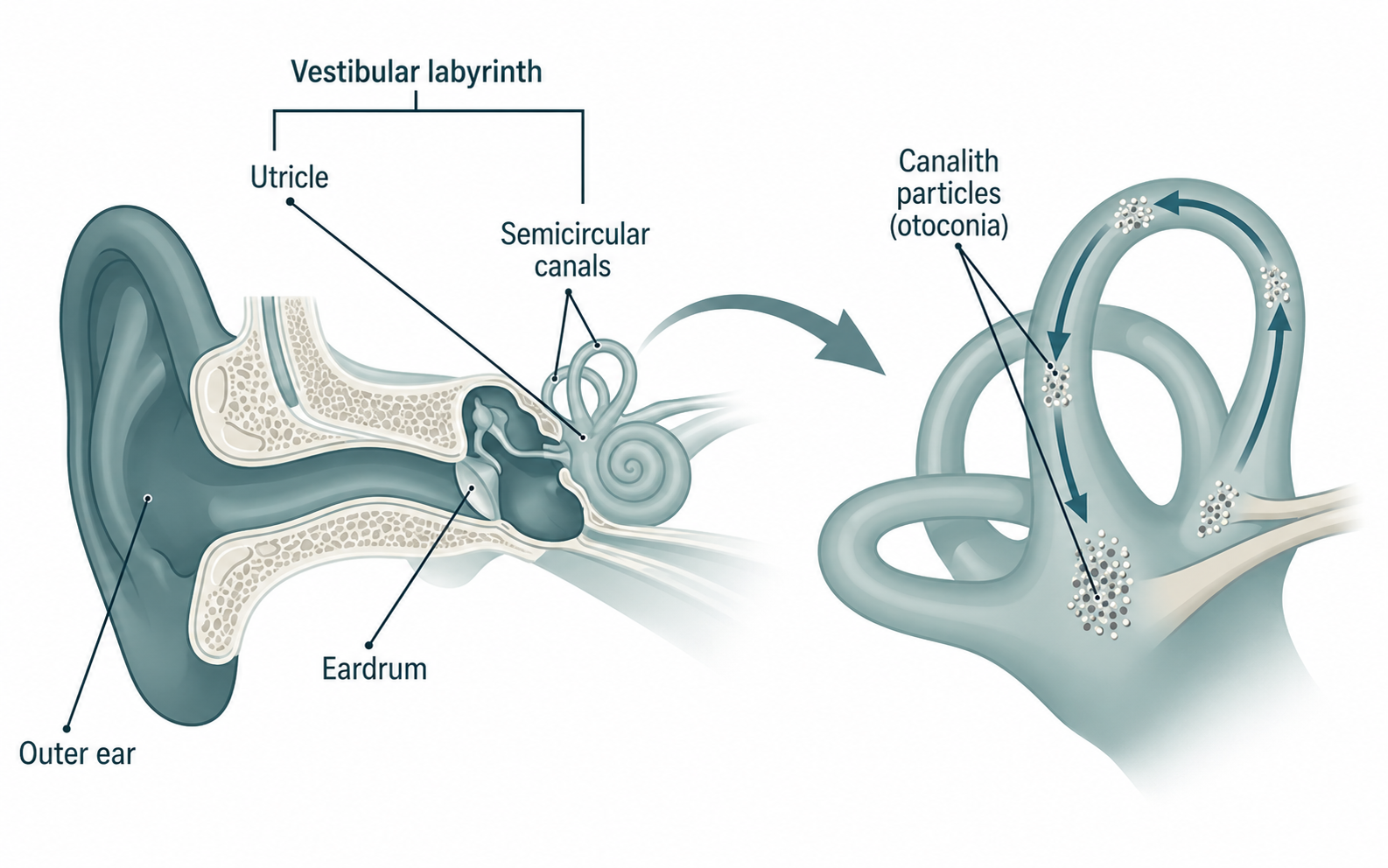
Inside your inner ear are tiny calcium carbonate crystals called otoconia.
Under normal circumstances, these crystals sit in a part of the inner ear called the utricle, where they help your brain detect gravity and head position.
Sometimes these crystals become dislodged and migrate into one of the inner ear's balance canals, called the semicircular canals.
When this happens, head movements can cause the misplaced crystals to move within the canal. This movement sends inaccurate signals to the brain about how your head is moving.
Your eyes, inner ears, and brain suddenly disagree about your position in space, resulting in symptoms such as:
Spinning sensations (vertigo)
Dizziness
Nausea
Unsteadiness
Feeling off balance
The good news is that these symptoms are often brief, usually lasting less than a minute, even though they can feel intense while they're happening.
Why Does Rolling Over Trigger It?
When you roll over in bed, your head changes position relative to gravity.
If crystals are sitting in the wrong place within a semicircular canal, that movement causes them to shift.
As the crystals move, they stimulate sensors within the canal and create the sensation that you are spinning, even though your body has already stopped moving.
This is why many people notice symptoms only with certain positions, such as rolling onto one side or lying back.
How Is BPPV Diagnosed?
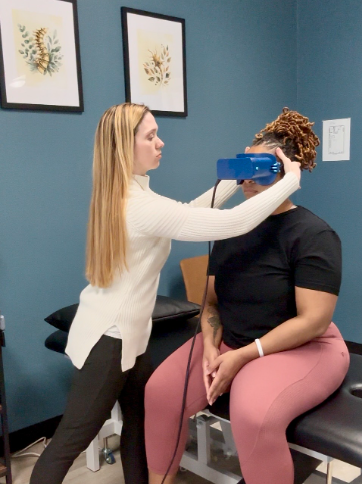
A vestibular-trained healthcare professional can perform specific positional tests that help determine:
Whether BPPV is present
Which ear is affected
Which semicircular canal contains the displaced crystals
During testing, clinicians also observe the eyes for a specific involuntary movement called nystagmus.
The direction and characteristics of the nystagmus help identify the exact location of the displaced crystals and guide treatment decisions.
How Repositioning Maneuvers Help
One of the most effective treatments for BPPV is a series of movements called canalith repositioning maneuvers.
These maneuvers are designed to use gravity to guide the misplaced crystals out of the semicircular canal and back into the utricle, where they belong.
Common repositioning maneuvers include:
Epley Maneuver
Semont Maneuver
Gufoni Maneuver
Barbecue Roll Maneuver
The specific maneuver depends on which canal is involved.
When successful, many people experience dramatic improvement in symptoms after just one or a few treatment sessions.
Why These Maneuvers Should Be Performed by a Professional
Because videos and online instructions are widely available, many people attempt repositioning maneuvers on their own.
However, successful treatment requires much more than simply moving through a series of positions.
The maneuver must be selected based on:
Which ear is affected
Which canal is involved
The direction of the nystagmus
The exact diagnosis
Additionally, the angles of the head and body must be precise enough to guide the crystals through the correct pathway within the inner ear.
Using the wrong maneuver, treating the wrong ear, or performing a maneuver with incorrect positioning may not resolve symptoms and can occasionally make dizziness worse.
A vestibular physical therapist or other trained vestibular specialist can accurately identify the source of symptoms and determine the most effective treatment approach.
When It Might Not Be BPPV
Although BPPV is one of the most common causes of dizziness when rolling over in bed, it is not the only possibility.
Other vestibular and neurological conditions can sometimes cause positional dizziness, including:
Vestibular migraine
Inner ear disorders
Central nervous system conditions
Orthostatic intolerance
Cervicogenic dizziness
This is another reason why a proper evaluation is important, particularly if symptoms do not follow the typical pattern of BPPV.
In Summary
If you experience dizziness when rolling over in bed, getting up, looking up, or changing head positions, BPPV may be the cause.
The good news is that BPPV is often highly treatable, and many people experience significant relief with appropriate vestibular assessment and repositioning maneuvers.
You do not have to simply wait for the dizziness to go away on its own.
A thorough vestibular evaluation can help determine the cause of your symptoms and identify the most effective path toward feeling steady again.


